A new method for growing high-quality lead halide perovskite crystals uses pyrolytic boron nitride (PBN) crucibles. These crucibles help produce crystals that are more stable and uniform. Researchers found that PBN’s smooth surface and chemical inertness prevent unwanted reactions during crystal growth. This leads to purer materials with fewer defects.
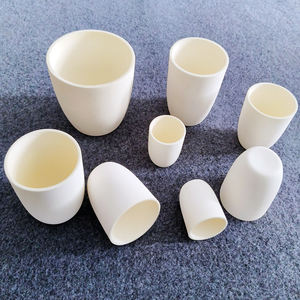
(Pyrolytic Boron Nitride PBN Crucibles for Growth of Lead Halide Perovskite Crystals for Detectors)
Lead halide perovskites are promising for radiation detectors because they respond well to X-rays and gamma rays. But making large, defect-free crystals has been hard. Traditional containers often contaminate the melt or cause uneven cooling. PBN crucibles solve these problems. They withstand high temperatures without breaking down. They also do not react with molten perovskite salts.
Scientists tested several crucible types and saw clear differences. Crystals grown in PBN showed better optical clarity and consistent structure. Their electronic properties were more reliable too. This matters because detector performance depends on crystal quality. Fewer impurities mean sharper signals and lower noise.
The team used a simple melt-cooling process inside a controlled atmosphere. The PBN crucible held the perovskite mixture as it slowly solidified. No extra steps were needed. The result was millimeter-sized single crystals ready for testing. These performed well in early detector prototypes.
Manufacturers may adopt this approach soon. PBN crucibles are already used in semiconductor production. Scaling up should be straightforward. Better crystals could lead to cheaper and more sensitive medical imaging tools. Security scanners and scientific instruments might also benefit.
(Pyrolytic Boron Nitride PBN Crucibles for Growth of Lead Halide Perovskite Crystals for Detectors)
This advance shows how container choice affects material outcomes. It opens a practical path toward commercial perovskite detectors. Work continues to refine growth conditions and explore other compositions.